Colours, Qualia and Questioning: some discussion on the theories of mind.

An excellent video on qualia and the explanatory gap. VSauce explains how we are – all of us – alone in our mind, and yet finds our shared humanity in our theory of other minds and our ability to question.

The description also has some excellent links to further study in these philosophies.

Posted in Philosophy of Mind | Tagged , , , , , | Leave a comment

Simone Weil: ‘A Need for Roots’

The Basis of Weil’s Philosophy:

Before Weil can enumerate her proposed Needs of the Soul she must first show what has caused these needs to arise, or at least to show what need there is of them. Even as she was writing societies (collectivities) had a system of rights and responsibilities by which they could govern citizens and by which citizens could expect fair treatment in their society.

Her first argument criticises the attempts to establish human collectivities from the perspective of the rights granted to its people. Rights she explains, must be recognised by others in order to exist. If someone does not recognise, or acknowledge, my rights and acts against them then I have little recourse. Rights are contingent and relative to circumstance, and so she does not believe that they should be the basis for establishing collectivities.

Instead she argues that collectivities should be based on the obligations its citizens hold to each other. Weil argues that every human holds certain obligations to all other humans merely because they are human. These obligations are universal, they are eternal, and they exist independently of whether anyone else acknowledges them or not.  If only one human existed in the universe she would have no rights (as there would be no one to grant her such), but she would still have obligations, to the world around her perhaps, and at least to herself. Collectivities then should be formed on the basis of obligations, not rights.

Weil examines these obligations and establishes that the soul, like the body, has needs which must be met. She argues that it is universally acknowledged (Weil puts forward a concept of universal conscience) to be wrong for someone with ample food to allow another human being to starve. There is an eternal and universal obligation to meet the needs of the body: food, shelter, warmth, etc… So too, Weil argues, there are needs of the soul which must be met if we are to provide for people to live a Good Life within the collective.

Weil goes on to enumerate these needs she first deals with how they can be used to assess the ‘health’ of human collectivities. Collectivities which provide well for the Needs of the Soul, and which minimise the conflict of obligations, are healthy. Weil acknowledges that it may not be possible to create a society in which there is never the feeling of conflicting obligations, and yet this is the ideal toward which collectivities should aspire.

Those that do not are ill. In some cases these collectivities can be improved or repaired, we can intervene to make them better meet the Needs of the Soul – just as a surgeon could intervene to improve the health of a patient, and just as with surgery this may require some short term cutting and pain for a long term good.

In other cases collectivities are actually harmful to the Needs of the Soul, to the extent that we could consider these collectives to devour souls rather than nourish. In these cases Weil advocates that the collective be pronounced ‘dead’ – beyond even surgical intervention – and if the collective doesn’t recognise itself as such it should be destroyed. Weil wants to go all chainsaw and shotgun on these zombie collectivities.

In establishing her list Weil acknowledges that we must not confuse ‘needs’ with ‘desires’, ‘whims’, ‘fancies’, or ‘vices’. In this she, like Aristotle, warns against using pleasure as a judge of what it is which our soul needs. This leads her to include several items in her list which are perhaps initially counter-intuitive, but she points out that poisons can be confused for food, and so too things which destroy our soul can be confused for that which would nourish it.

The List:

Order: By which she means an harmonious social order which minimises the conflict of obligations and under which one feels the same sense of wondrous order as is in the infinite universe. Here Weil discusses her argument of antithetical pairs and the importance of balance. This is a very apt section for comparisons with Aristotle’s Golden Mean.

Liberty: by which she means the ability to freely choose. This should not be confused for absolute freedom; Weil does not believe Liberty is achieved by more relaxed rules, but by ensuring rules are well understood, limited, stable and handed down by respected authority.

Obedience: which the people of the collective must give not by coercion, but by consent. Those who rule by fear or promise of reward do not allow their people to be obedient to them. They rule by forced servility rather than voluntary submission, and deny their people this Need of the Soul. Leaders must be held highly accountable to their people.

Responsibility: People must be called upon at times to make decisions beyond their own interests. They must feel that they are contributing in some way to the collective and understand their place within it. This can be achieved through work, education or social groups.

Equality: (is that Nietzsche I hear? His rage echoing through the decades?) Weil doesn’t deny that there should be leaders and social stratification, but this Need of the Soul requires that the inequalities of the collective are not determined by any single factor (gender, socio-economic, race, etc…). She suggests that equality is achieved through social mobility, both upward and downward. The soldier should admire the general, but the general should admire the soldier. They have different social roles to play, but are equally respected.

Hierarchism: Not of individuals, but of symbols. I should devote myself to the respect of the hierarchical symbols of the collective (Ministers, Prime Ministers, Governors General, The Monarch) rather than an individual who fills this role at any given time. Likewise the individuals in these roles must recognise that it is the role which exists in the hierarchy, not themselves.

Honour: Honour is granted in addition to respect. We must respect all human beings simply because they are human, but where someone is ‘keeping alive’ the noble virtues then that person should be publicly recognised and honoured. Social prejudices which deny honour to those that deserve it are harmful to the soul.

Punishment: Weil suggests two types of punishment: disciplinary and penal. Disciplinary punishment is corrective, meant to provide external support to people’s failings. Penal punishment is a way to bring the soul back to its eternal obligations. If the person punished consents to this they may be fully returned, but if not it can only be partial. Punishment should not be a method to control people through fear, but should be given as an honour, to remove the stigma of crime, and as an education. The severity of the punishment should match the crime and those higher on the social scale should be more punished for transgressions because of their greater responsibilities. Weil’s views on punishment are very much comparable with Socrates’.

Freedom of Opinion: Weil states that ‘unlimited freedom of opinion, without the least restriction or reserve, is an absolute need on the part of the intelligence’. Even evil arguments could be explored, but not commended. Censorship should occur where the media in which the opinion is put forward is overly persuasive or influential (such as in newspapers of on TV). Collectives must be protected from propaganda, from vulgar and base material, and from persuasion of the state. Individuals have freedom of opinion, but collectives should not have opinions. Political parties should be abolished and the ‘single party’ state is the worst evil of all. Ultimately we should have freedom of opinion, but Weil draws a distinction between thought and act.

Security: This protects people against fear and terror which are poisons of the soul. Threats of unemployment, police persecution and foreign threats can all cause fear and terror. Even if it is latent it can cause in people a kind of paralysis.

Risk: Like fear risk involves a degree of danger, but unlike fear it does not crush the soul because it allows a deliberate reaction and sustains our courage. Without risk our soul is semi-paralysed.

Private Property: which Weil considers as an extension of one’s body. My ownership of this property must be recognised by law and ideally should include a home, land, and tools for my trade or profession. Collectivities which require their people to work the land for others (such as Feudalism) do not meet this need.

Collective Property: A collective should have monuments, gardens, public space, etc… which belong to the people. When money and profit become the most important things in a collective this need is not met because everything is given to private ownership.

Truth: This is the most sacred of needs and so a collectivity must work to ensure that standards of truth are maintained. Journalism in particular must be held to standards of truth. It is not enough that there be public suspicion of lying. If falsehoods are published, either negligently or deliberately – especially in the case of propaganda – then the people responsible should be punished. If needs be there should be specialist courts with expert judges established to ensure that this need is met.

Posted in Uncategorized | Tagged , , | Leave a comment

Nietzsche Revision

The First Essay:

Nietzsche first defines his terms. He explains that ‘good’ can have two meanings, and that though these are similar we can see the difference in their antonyms. ‘Good’, as opposed to evil, is different from ‘good’ as opposed to ‘bad’. When we go in search of the ‘good life’ then we must carefully consider what we mean by this. A tyrant’s life (as Callicles and Socrates debate it) might be ‘good’ in the sense that he is healthy and wealthy, is powerful, has his desires fulfilled etc… this is clearly not a ‘bad’ life in the sense of a person whose existence is pain and poverty and suffering. This concept is separate though from what modern morality considers the ‘good’ life. The ‘good’ in modern morality is opposed not to ‘bad’ but to ‘evil’. Nietzsche uses this distinction to argue that there are actually two very different moralities which have operated.

The morality of the noble man, or the masters, was the original morality. It was a positive acclamation of the good as opposed to bad. The masters understand their morality in terms of self-satisfaction, and express it in terms of praise. They look down on those beneath them, perhaps with pity, perhaps with contempt, or perhaps with no feeling at all. Their focus is not on those beneath them but on their own capacities and achievements. What is within their power to achieve is ‘good’ and whatever prevents them from achieving, or keeps people lowly, is ‘bad’. Nietzsche understands this process as a part of the natural world, and he draws his analogies from the communities and social stratifications of nature. He refers to the birds of prey as superior to the lambs they hunt, and to lions as the most superior of the beasts. At times this morality can be violent, even savage; it can be a means of conquest and rule, but it does provide to elevate the superior above the inferior.

The other morality, the morality which Nietzsche sees around him as the tool of the Judeo-Christian and Western Philosophical traditions, is a ‘slave morality’. Here ‘good’ is not opposed to ‘bad’ but to ‘evil’. Where the noble morality was created by an affirmation, by giving a YES to what is good, the creative deed of slave morality is to say NO to what is evil, to anything which is different from, or outside, the morality itself. This process is driven by what Nietzsche labels ressentiment, a term closely related to, but more specific than, resentment. The slaves recognise that they are lowly creatures, and yet instead of looking within for what keeps them low they look outwardly, to the masters above them, and they cast the blame for their own misfortunes and failings on these others. The slaves resent the masters their ability to achieve and succeed, and so they view the masters with jealousy and hatred. The slaves are kept down not by their own inadequacies but by the tyranny of the masters, and so the masters are iterated as ‘evil’. Thus to be ‘good’ is to be unlike the masters: it is determined not by how we act, but how we react (turn the other cheek), it prescribes behaviour rather than promoting action (thou shalt not, rather than thou shalt), it creates a value system that rewards humility and inaction, which congratulates the slaves for not doing what they were anyway incapable of doing, which promotes equality rather than encouraging greatness, hence those who strive against it, who try to rise above it, are viewed suspiciously as ‘evil’.

The Third Essay:

Here Nietzsche takes up a critique of the ‘ascetic ideal’ of both religious and philosophical history. Asceticism is a rigorous self-denial, austerity, self-denial and abstinence. That this is valued, even idolised, in religion is easily shown, (Buddha’s time under the Bodhi tree, Fasting rituals in the Islamic faith, the crucified Christ as redeemer…) and Nietzsche is scathingly critical of religious morality, especially the Christianity that was dominant in his own lifetime. He is also critical though of the Western philosophical traditions which promote ascetic values as moral good. You might here think again of Socrates’ arguments to Callicles that one should have modest desires and be content that they are fulfilled, or of Aristotle warning against excess and promoting self-discipline. Nietzsche draws on the tradition among philosophers of valuing the mind at the expense of the body, at seeking to fulfill the quiet contemplative and ultimately spiritual needs, and yet disdaining the fulfillment of the physical needs, and yet he doesn’t damn them entirely. For philosophers, he concludes, like artists, asceticism is pragmatic. Philosophers (and artists) are unusual, and suspiciously regarded by most people, and so they must conform to a certain previously established ‘type’ in order to exist – they take on the form of contemplative men: the sorcerer, the mage, the wise-man, the soothsayer… the priest.

The priestly types than are the true advocates of asceticism. Asceticism in priests, like the slave morality itself, is born of ressentiment. In this case it is life itself, physical existence, which is cast as evil, and asceticism is then the denial of it. The ‘good’ is a spiritual one, the promise of another world beyond the hardships of our life as we must live it here. The ascetic priest becomes the shepherd of a flock, a care-giver, a self-sacrificial saviour, and his kingdom is a dominion over the suffering. His use of Christian symbolism here is quite deliberate (and telling), but we should recognise that his critique can be applied more broadly than simply to Christianity.

Beyond the prescribed:

His furthers his critique with an analogy to the physician (though we may think of a surgeon rather than a GP). The priest acts as a physician, a healer, and yet Nietzsche explains he must first create the wounds he intends to heal, and in doing so he infects his patient. For Nietzsche the person suffering under ressentiment is actually in a state of genuine physiological depression. The priest’s role then is first to cause this psychological depression with the religious dogma which values the ascetic and which denies the ‘evils’ of the master morality. In treatment of this depression the priest provides a religious rationalisation for the feelings of ressentiment. The priests recast, or redirect the ressentiment into ‘sin’ and ‘guilt’ so that the patient can combat these feelings with regular and easily attainable petty pleasures. Christian asceticism then allows us to overcome our depression and impotencies with “orgies of feeling” in which we can subject ourselves to self-incrimination (forgive me Father for I have sinned…), self-doubt, and self-punishment (penance).

Posted in Uncategorized | Tagged , , , , | Leave a comment

Armstrong’s Nature of Mind Revision

Summary of concepts:

Armstrong suggests that it is right for contemporary philosophers to believe that the best tool (method) we have to discovering the true nature of the human mind is science. Scientists he admits may disagree, but modern science accepts a “purely physico-chemical account of man.” (This is its paradigm – so to speak). Scientists who disagree with this paradigm usually do so from religious or moral perspectives, rather than having valid, scientific objections.

Armstrong gives several reasons for allowing science the authority in this matter, citing (among other things) its ‘unique’ ability to reach a consensus and its capacity for progress.

If we accept that science has the authority Armstrong claims it is reasonable to create an account of the mind that is compatible with the view that man is nothing but a physico-chemical mechanism. This is most obviously achieved by a Materialist/Physicalist account of the mind.

Note that Armstorng doesn’t specifically set out to prove that the mind has a material/physical existence, his goal is simply to create an account compatible with materialism/physicalism.


To do this Armstrong starts with traditional descriptions of the mind which might be consistent with materialism/physicalism. He begins with Classical Behaviourism, but rejects it on the grounds that it doesn’t adequately explain his concept of mind. He then considers Dispositional Behaviourism, and seems to approve of the introduction of dispositions, yet ultimately he rejects this too as unsatisfactory. It is then for him to develop his own account, an extension of Dispositional Behaviourism.


Armstrong’s account ultimately sets out to show that ‘mental states’ can be identified with physical states of the central nervous system. That is to say that they are one and the same thing. When I describe anger, or love; of my desire for a new iPhone or a chicken dinner; of a preference for a particular musical style; of my ambition to a particular career; of any decision I have made; of a particular story or image I have imagined, I am actually describing a physical state of my central nervous system – that is the pattern of electro-chemical interactions in my physical body.

Arguments and criticism:

The Authority of Science:
Armstrong requires that we accept science as having greater authority than other fields of human endeavour. What arguments does he use to justify this claim, and how might we criticise these arguments?
Defining Mental States:
Armstrong considers Behaviourism as a possible solution, but rejects it on the grounds that it is too crude.

What strengths and weaknesses does he identify in the Behaviourist argument and what counter-argument does he make in rejecting it?
Armstrong seems to approve of the Dispositional Behaviourist notion of a disposition to behave. What analogies does he use to show its attraction and why then does he ultimately reject this too as being inadequate?


In putting forward his own, physicalist, account of mind Armstrong uses dispositions as a starting point but attempts to understand them as ‘a scientist would’.

How does he apply a scientific process to the problem of dispositional behaviourism and is this an appropriate argument to make in support of his account of mind?

The Problems Armstrong anticipates:


The problem of consciousness is often made of Behaviourism – it is an other-person point of view and never a first-person account. It may be accurate to say that we observe the behaviour of others – for that is all we can observe of them – but that is not how we observe our own minds.


This criticism may also apply to Armstrong’s account of mind. How does Armstrong respond?


How does the analogy to the distracted driver provide an example by which Armstrong can demonstrate his argument?


How does Armstrong use an analogy to keys and locked doors to demonstrate a defence of dispositions?


Prompt Questions for critical evaluation and comparison:


How does Armstrong describe consciousness, and is this a convincing account?


What are the strengths of Armstrong’s defence against the anticipated arguments?


What weaknesses remain?


Is there any other way by which we might refute Armstrong’s account?


Armstrong believes that this account is compatible with behaviourism, and he seems to have shown that it is, but does that mean it is necessarily physicalist?


Is Armstrong’s account of mind a disproof of Cartesian Dualism, or might the two be consistent or compatible?

Posted in Uncategorized | Tagged , , , , , | Leave a comment

Revision notes for Descartes’ Meditations

Meditation I (Concerning those things that can be called into doubt)

Descartes is attempting to find out if anything is indubitable. He is not trying to disprove the existence of everything, nor is he trying to suggest that this process is a legitimate way of navigating the world. He is setting up a deliberately stringent test of what he can be certain of: what is beyond any doubt. This will be the unshakable foundation of his other beliefs.

He begins this process by doubting all the information he gains by his senses (bear in mind this is at a time when science is a growing power in the intellectual culture of Europe and empiricism – that knowledge is gained by observation – is an increasingly dominant paradigm. Descartes challenges this, attempting to show that the basis of science – and knowledge – is rational rather than empirical).

He justifies this doubt by suggesting:

  • My senses have deceived me in the past
    • When things have been far away or indistinct
    • When I have interpreted my sense-information in error
    • My senses have no connection to the outside world: they do not connect me to any external object, but only with mental ‘images’ in my mind. There is therefore no certainty to be gained through the senses that any external object exists.

He establishes 3 arguments to support his doubt:

  • I often have perceptions very much very much like the ones I usually have in sensation while I am dreaming
  • There are no definite signs to distinguish dream experience from waking experience

Therefore:

  • It is possible that I am dreaming now and that my perceptions are false.

Deceiving God:

P1:

P2:

C:

Evil Demon:

P1:

P2:

C:

Meditation II (Concerning the nature of the human mind: that it is better known than the body)

Descartes’ Epistemology:

In this meditation Descartes builds on his established doubt in the senses. If his senses are not beyond doubt, then what else might he use to find an indubitable truth (if such a thing exists?)

Descartes describes an understanding of the senses which has come to be known as representationalism or indirect realism. In doing so Descartes advances a philosophical field which can be traced back to Ancient Greece and the writings of Aristotle and Plato.

Descartes believes that it is not possible for the mind to perceive an external object directly. Instead our mind perceives ideas, or representations, of external objects. When I perceive an object it is the idea, or representation of that object in my mind which I perceive, rather than the object itself.

In this way Descartes explains that all of the contents of the mind are ideas: not only our perceptions, but all of the images, memories, concepts, beliefs, intentions and decisions which exist in our minds.

He believes that the ideas, the mental perception of objects, is separate from the object itself, and that our perceptions can either be accurate or inaccurate in the way they represent the external object.

By this theory Descartes argues that the external world is disconnected from the internal (mental) world, and indeed calls into doubt even the existence of an external world.

Descartes’ indubitable truth:

I have convinced myself that there is nothing in the world — no sky, no earth, no minds, no bodies. Doesn’t it follow that I don’t exist? No, surely I must exist if it’s me who is convinced of something.”

He returns to his arguments for doubt that he outlined in Meditation I and applies the concept of a malicious deceiver, an all-powerful and deceptive demon, and finds that even in this case his existence is indubitable: “But surely I exist, if I am deceived.”

Having secured his existence Descartes then seeks to explain what is this thing which is him. In doing so he rejects previous attempts to define what a person is (such as ‘a rational animal’) and instead seeks self-evident truths.

“But what then am I? A thinking thing. And what is that? Something that doubts, understands, affirms, denies, wills, refuses, and also senses and has mental images”

The ‘wax’ argument:

Descartes uses the example of wax to show that it is not by our senses that we know the nature of things. He demonstrates that the wax in his example can be perceived not by the senses but by “intellect alone”. If this is true of the wax then so too may it be true of ourselves. We can know the self not by what we sense (our bodies) but by what we can perceive by intellect alone (our mind – the ‘thinking thing’). Indeed Descartes goes on to say that he “can’t grasp anything more easily or plainly than [his] mind.”

Posted in Descartes | Tagged , , , , , , | Leave a comment

Annotated text of Thomas Kuhn’s “Structure of Scientific Revolutions”

See below my annotations on a pdf version of the set text. This is not identical to the prescribed edition of the text, so you’ll still need to refer to your own and where there’s a conflict prefer your prescribed text’s version.

Kuhn-SSR-2ndEd (Annotatedfor VCE)

I’ll be adding similar resources for the other set texts in the coming days.

Posted in Knowledge, Belief and Science, Kuhn, Unit 4 | Tagged , , | Leave a comment

Falsification

Amazon gives a summary of Popper’s essays in ‘Conjectures and Refutations’:

“The way in which knowledge progresses, and especially our scientific knowledge, is by unjustified (and unjustifiable) anticipations, by guesses, by tentative solutions to our problems, by conjectures. These conjectures are controlled by criticism: that is, by attempted refutations, which include severely critical tests. They may survive these tests; but they can never be positively justified: they can neither be established as certainly true nor even as ‘probable’ (in the sense of the probability calculus). Criticism of our conjectures is of decisive importance: by bringing out our mistakes it makes us understand the difficulties of the problems which we try to solve. This is how we become better acquainted with our problem, and able to propose more mature solutions: the very refutation of a theory – that is, of a tentative solution to our problem – is always a step forward that takes us nearer the truth. And this is how we can learn from our mistakes. As we learn from our mistakes our knowledge grows, even though we may never know – that is, know for certain. Since our knowledge can grow, there can be no reason here for despair of reason. And since we can never know for certain, the can be no authority here for any claim to authority, for conceit over our knowledge, or for smugness.”

Like Hume then Popper seems to ultimately have a sceptical view of knowledge: It is not possible to achieve certainty, merely probability. The ‘anticipations’, ‘guesses’, and ‘hypotheses’ of science are always unjustified and unjustifiable. Hume explains that this justification is lacking due to our unsupported supposition that the future will conform to the past. Popper accepts that I have no rational justification for any theorising of science.

How then does science proceed? How can science be said to bring us closer to ‘knowledge’ if it provides only probability and never certainty?

Popper sees science as a series of ‘conjectures’ (the guesses we make make about what may be true) and ‘refutations’ (which test the reliability of our conjectures). For this view of science to operate effectively the conjectures we make must be refutable. We must accept that it is possible to show that the conjecture is false. Popper labels this quality ‘falsifiability’.

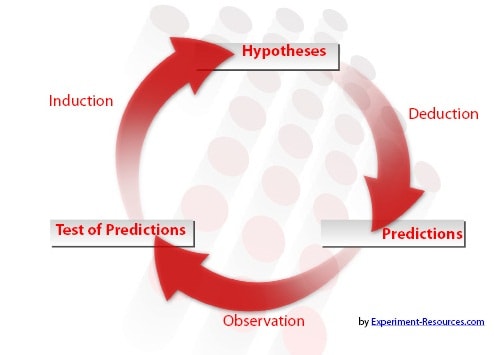
Since Popper’s writing ‘falsifiability’ has become (while not universally accepted) a foundation for the modern scientific method. Consider the diagram below:

Reasoning Cycle - Scientific Research

When we create an hypothesis we can deduce from it some predictions of the future. We can then conduct an experiment, or observe the natural world to test our predictions. From these observations (empirical reasoning) we can induce the necessary alterations to our hypothesis, or in the event that it’s confirmed we can accept it as more highly probable. We can then make further predictions from our new hypotheses and the process continues refining itself.

“All swans are white” is a falsifiable theory. I can falsify it with the observation “this swan is black” The statement “white swans exist” is not falsifiable however (nor for that matter is the statement “pink swans exist”). In both cases we cannot prove the statement with certainty using a positive method. No matter how many swans I observe I cannot logically induce a general rule from individual observations with certainty. I can prove with certainty that the falsifiable statement is false though, and in doing so I progress science by forcing a new hypothesis to be created.

Bertrand Russell put forward a theory (deliberately absurd and unfalsifiable) that a teapot was orbiting the sun on a path between Earth and Mars. Such a theory fails Popper’s test of falsifiability, because there is no experiment I could conduct, and no observation I could make (the teapot is too small to be seen by telescope), which disproves his theory. Russell’s point was that to assert this theory, and to insist – on the grounds that it has not been refuted – that the theory be accepted as truth is nonsensical.

Using Popper’s falsification test we can assess whether a claim, or theory, is genuinely scientific. A scientific claim will be (or should be) falsifiable. A claim which is clearly not scientific (“Beyonce is better than Nicki Minaj” for instance) need not be falsifiable, provided I don’t try to suggest that it is science. Where a claim seems scientific, or is presented as science, but is not falsifiable, we can classify that claim as pseudo-science. Popper felt that this was a black and white distinction. He felt that falsification could differentiate between science amnd pseudo-science, but more recently people have begun to accept that there may be some grey area between.  Some pseudo-sciences are a dark grey, others are light grey.

But what of Russell’s teapot? The theory may be obviously unfalsifiable today, but in the future some technological or exploratory process may be put in place which allows us to conclusively prove that such a teapot does not exist. Does this show that Popper’s black-and-white view of falsification, of science and pseudo-science is flawed?

It’s important to remember that just because something is not falsifiable doesn’t necessarily mean it is not true. “My child is beautiful” may well be true, but I cannot falsify it (much like my Beyonce v Minaj example earlier). Likewise, a statement like “Angels exist” is not falsifiable, but that doesn’t mean we can automatically reject it as false. Even Russell’s Teapot was not supposed to deny the existence of God (Russell did that too though), it was meant to demonstrate that the theists had the burden of proof.

Posted in Knowledge, Belief and Science, Popper, Unit 4 | Tagged , , , , , , , | Leave a comment

Hume’s Chapter on sceptical doubt

The pdf slides I referred to in class recently are available here (with thanks to the work of Mr Ross Barham of Melbourne High School)

Posted in Hume, Knowledge, Belief and Science, Unit 4 | Tagged , , | Leave a comment

David M Armstrong

Philosophy Unit 4, Area of Study 1.

Learning Intention:

To understand the historical and cultural influences on the writings of David M Armstrong.

Reading:

David Malet Armstrong was born in Melbourne in 1926. He became one of Australia’s most respected philosophers, described as having a ‘claim to being the greatest philosopher produced by the young and vast country of Australia’. Having studied at Geelong Grammar, the University of Sydney, Oxford University in England (1952-54) and being awarded a PhD from University of Melbourne in 1960, he is currently Emeritus Professor of Philosophy at the University of Sydney. His early publications were focussed on the Idealist philosophy of Bishop Berkeley, and he deserves an international reputation as a philosopher on this basis, but it is his subsequent contributions to epistemology and metaphysics for which he is most well-known.

Rigorous metaphysical philosophies were out of fashion in the early 1960s. The philosophies of Wittgenstein and particularly his focus on linguistic principles and semantics in philosophy, a movement centred on Oxford University, had overshadowed the work of Betrand Russell and others (including Armstrong’s teacher John Anderson) . Armstrong produced a series of lucid arguments for both physicalism (in the 1960s) and metaphysical universals (in the 1970s). He described laws of nature as relationships between these universals (in the 1980s) and most recently argued for physical universals as ‘truth-makers’.

Armstrong has based his metaphysics on three theses:

  • Common sense – Armstrong believes that some beliefs are so securely grounded in human experience that any philosophical objection to them undermines the philosophy rather than the belief.
  • Scientific Naturalism – Armstrong believes that a complete science will give a complete account of everything.
  • Actualism – Armstrong rejects knowledge of things which are merely possible or dispositional.

His metaphysics then rests on the belief, perhaps the assumption, that it is possible to achieve a systematic, unified account of everything.

In 1968 Armstrong published A Materialist Theory of Mind in which he responded to Gilbert Ryle’s The Concept of Mind(1949). Where Ryle argued for behaviourism which was based on mental dispositions, Armstrong instead argued for a functionalist analysis of mental states. He claimed that neurophysiological states played causal roles in our behaviour and are therefore identical to mental states.  He argued that pain (for instance) is more than the ‘mere’ disposition to behave in certain ways, but that pain is caused by a certain pattern of nerve activity, and therefore that pain is identical to this pattern. In this way Armstrong argues that mental states are physical states.

Independently:

  • Research the philosophers Bertrand Russell and John Anderson. Consider how these philosophers (Anderson directly) influenced Armstrong.
  • Research Ludwig Wittgenstein, particularly his philosophy on the relationship between the world and the mind, and the influence of language on this relationship.
  • Research Gilbert Ryle, particularly his concept of mind to which Armstrong responds.
  • Develop definitions for (and an understanding of):
    • Disposition (as it relates to Dispositionalism)
    • Actualism (as opposed to Dispositionalism)
    • Physicalism (as it relates to philosophy of mind)
    • Behaviouralism (as it relates to philosophy of mind)

Response:

Considering the set text as a product of a certain historical time and a certain culture explain how they help us to answer the following questions:

  • How important is the distinction between mental states as dispositions and mental states as physical causes?
  • Is ‘common sense’ to be trusted, or was Descartes right to reject anything which can be exposed to doubt?
  • What is the relationship between the body and the mind as described by Armstrong and how does this differ from Descartes’ account?

If you can’t source a copy of the required reading try here:

Posted in Armstrong, Nature of Mind and Body, Unit 4 | Tagged , , , , , , , , , | Leave a comment

Descartes Lesson 1


His Life:

René Descartes was born March 31st 1596 in a small town named la Haye, south of Tours in central France. The town has since been renamed ‘Descartes’ in his honour and the house in which he was born is a tourist attraction. René was the fourth child. His mother died in childbirth a year after he was born. His father’s position as a judge in the High Court of Brittany (at Rennes – 140 miles away) meant he was only at home half the year, and so he was raised in his grandmother’s home (though his main attachment was to his nurse).

As a child Descartes was sickly and solitary. At eight he was sent to a Jesuit College boarding school which had recently opened in la Flèche. The rector of the college was a friend of Descartes’ family and thus René was given a private room of his own and allowed to wake up whenever he liked. He developed the habit of rising around noon – and maintained the habit throughout his life. His health improved while at the college, aside from a continuing case of hypochondria.
Despite his successes in education he found little meaning in the teachings of the Jesuits, except for mathematics. He craved certainty, and the rehashed interpretations of Aristotle and the theology of St Thomas Aquinas left him, like Socrates, convinced he knew nothing. His only certainties were in mathematics and in God.

At sixteen Descartes left the college to study law at the University of Poitiers. His father wanted him to become a respected member of the legal profession, as René’s older brother had done. At the time these positions were commonly filled through nepotism and the Descartes family were well connected. After two years he had received a baccalaureate of law. He had by this stage inherited some small rural properties from his mother and these provided him with an income to do as he pleased. Against the wishes of his father, he moved to Paris to ‘pursue his thoughts’.

After two years in Paris, during which he devoted himself to a wide range of studies and wrote a few treatises, he was becoming bored. He had become more involved in the social life of Paris and had come to find it tedious. Descartes tended to find all social-life tedious, a product perhaps of his solitary youth. He moved again, this time to Faubourg St Germain, where he could live in seclusion and pursue his thoughts in peace. This became something of a pattern throughout Descartes life. He seemed to be torn between a desire for solitude and a desire for travel.

It seems a strange decision then that in 1618 Descartes (who claimed to be a devout Catholic, but was accused several times in his life of promoting deist, or atheist ideas) joined a protestant army defending the United Provinces of Holland from the catholic Spanish. He signed on as an unpaid officer in service to the Prince of Orange. He spoke no Dutch and had no military experience beyond ‘a bit of fencing and riding’ he’d learnt while at school. Perhaps it is best explained in Descartes’ own words from Discourse on the Method. He resolved to travel the world, visiting courts and armies, and “to seek no knowledge other than that of which could be found in myself or else in the great book of the world”.

During his time in the military he steadfastly kept his habit of rising at noon. Again though he became bored by life in the army and he (perhaps ironically) complained of the idleness amongst the troops. erved in , but as the armies were currently in truce he was able to spend much of his time contemplating mathematics. It was at this time that Descartes met Isaac Beeckman, with whom he pursued the mutual belief that a method could be found to link mathematics and physics.

After a year in service to the Prince of Orange Descartes travelled again, this time to Germany, where he entered a new military service with Duke Maximilian of Bavaria. In November 1619, while stationed in Bavaria, Descartes experienced three dreams which would shape his future life. In the first dream Descartes is in his old college in la Fléche, and struggling against a strong wind. In the second he is in darkness until he experiences ‘a noise like a crack of lightning’ and the darkness is filled with sparks. In the third he was at his desk, whereupon there is a dictionary and a book of poems. In his interpretation of these three dreams Descartes becomes convinced that he must pursue a God-given vocation, and he develops a confidence that he can find truth in the application of the rational mind alone.

In 1622 he returned to France and continues his travels. While in Paris he published his first essay on method (Rules for the Direction of the Mind). He sold his properties and invested instead in bonds, which provided for him throughout the rest of his life.

Between 1628 and 1649 he returned to the Dutch Republic. He attended several universities either as a scholar, or in the case of Leiden University, enrolled under a false name. During this time he had a falling out with his old friend Isaac Beeckman amid claims that Beeckman had plagiarised Descartes’ ideas. He also fathered a daughter by a servant girl while in Amsterdam. His daughter (Francine) died of scarlet fever in her youth.
It was also in these decades that he wrote all of his major works. When Galileo was put on trial by the Roman Catholic Church in 1633 Descartes abandoned his plan to publish Treatise on the World, on which he’d spent four years working. Instead he published parts of this work in three separate essays in 1637. These essays (The Meteors, Dioptrics, and Geometry) were preceded by an introduction entitled Discourse on the Method in which Descartes outlines four ‘rules for thought’ meant to ensure that our knowledge has a firm foundation.

His Meditations on First Philosophy was published in 1641. It was written in Latin, an indication that its intended audience were those already well-learned. In it Descartes extends on his rules of thought introduced four years earlier. This, along with his later Principles of Philosophy, is among his most important philosophical works, and it remains one of the most important metaphysical treatises in the history of Western Philosophy.

Descartes died on February 11th 1650 in Stockholm, Sweden where he had been employed as a tutor to Queen Christina. One theory behind the cause of his death was that the queen’s demands for early morning study severely compromised Descartes’ immune system. His remains were initially buried in Sweden in a cemetery reserved for unbaptised babies (Descartes being a Catholic meaning he couldn’t be buried in ground consecrated by the Protestant Church of Sweden). Later his bones were returned to France, and though there were, for a time, plans to have him interred in the Panthéon in Paris his bones remain in a side chapel of the Abbey of Saint-Germain-des-Prés.

In 1663 his books were placed on the List of Prohibited Books by the Roman Catholic Church (the list was formally abolished in 1966 by Pope Paul VI). After Descartes death Queen Christina, daughter of a protestant war-hero, abdicated from the throne and converted to Roman Catholicism (it was against Swedish law for a Catholic to hold the throne). The only significant Catholic influence in her life was Descartes.

Independently Research:
• The Spanish – Dutch conflict (The Eighty Years’ War).
• Isaac Beeckman
• The trial of Gallileo Galilei
• Deism

Responses:
Why do you think the three dreams Descartes had in Bavaria are considered so important to his later work?

What influence do you think religion had in Descartes’ life and philosophy?

Why do you believe the Roman Catholic Church would have been so opposed to Descartes’ work that they posthumously placed it on a ban list?

Is Descartes’ philosophy consistent with his claims that he was a devout Catholic, or is it an inevitable consequence of his work that he would assume a deist, or atheist position?

Posted in Descartes, Nature of Mind and Body, Unit 4 | Tagged , , , , | 1 Comment